
AMIKO Anwält:innen
Nordstrasse 20
8006 Zürich
Auf Karte anzeigen
T: +41 43 543 30 30
E: kanzlei@amiko.law
AMIKO Anwält:innen
Nordstrasse 20
8006 Zürich
Auf Karte anzeigen
T: +41 43 543 30 30
E: kanzlei@amiko.law


Text: Markus Loher, Solicitor
Image: Google Gemini
Date: 02.10.2026
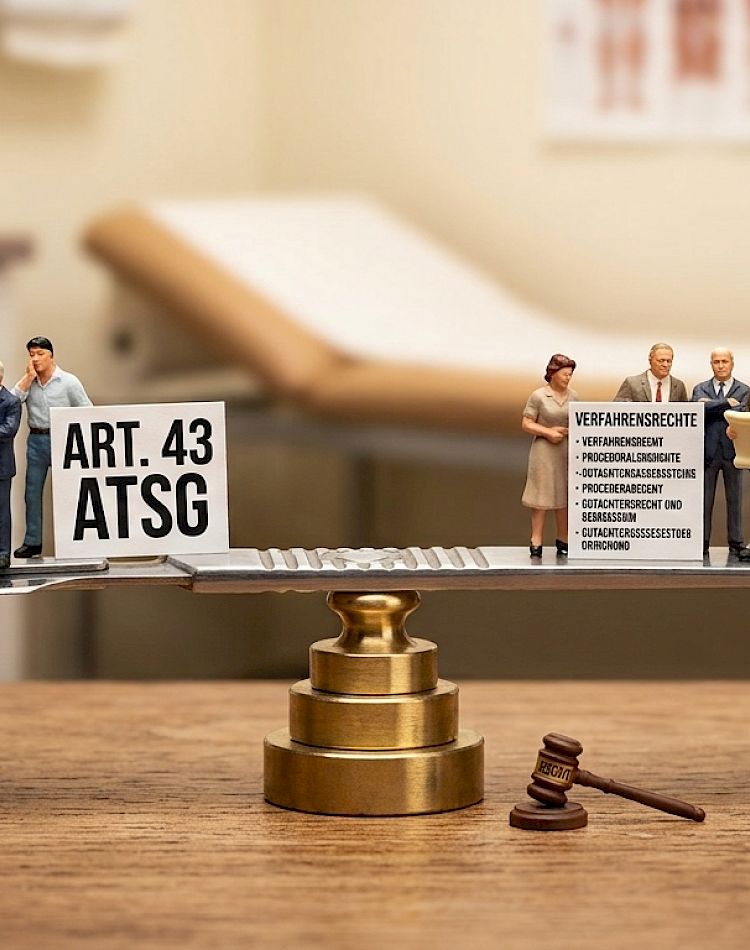
The order for a medical assessment in an IV procedure, where there is disagreement regarding the necessity and arrangements for such an assessment under Article 44 of the ATSG, must still be served by means of an interim decision. The Federal Supreme Court’s decision of 10 July 2026, 8C_445/2025 (scheduled for publication), follows on from the discussion that has been ongoing since the ‘Further Development of Disability Insurance’ reform regarding the rights of insured persons to be heard and to participate in the assessment process. In it, the Federal Supreme Court confirms its previous case law in accordance with BGE 137 V 210 and BGE 139 V 349.
The decision was based on a scenario that repeatedly gives rise to disputes in practice: following the receipt of a multidisciplinary expert report certifying total incapacity for work, the disability insurance office deemed further medical investigations necessary and ordered a new assessment. The insured person demanded that this not merely be decided informally, but that an appealable interim decision be issued. The Social Insurance Court of the Canton of Zurich upheld the complaint alleging denial of justice and instructed the IV office to issue a corresponding interim decision. The Federal Supreme Court upheld this decision and dismissed the appeal lodged by the IV office.
The main issue centred on the interpretation of Articles 43 and 44 of the ATSG, as amended with effect from 1 January 2022. The IV office and the Federal Social Insurance Office (BSV) based their arguments primarily on the wording, structure and purpose of the ‘Further Development of Disability Insurance’ amendment. Articles 44(2) and (4) of the ATSG stipulate that an interim decision must be issued only if, despite a party’s application for recusal on grounds of bias, the designated expert is retained. It could be inferred from this that the legislature deliberately intended to restrict the form of the decision to matters of recusal. Furthermore, Article 43(1bis) of the ATSG expressly emphasises the insurance provider’s authority to determine the nature and scope of the necessary investigations. Furthermore, the revision was clearly guided by the principle of simplifying and expediting the proceedings. From the perspective of the IV office, it therefore seemed logical to assign the ordering of the assessment to the administration as a matter of principle and to deal with objections to it only in the context of an appeal against the final decision.
The Federal Supreme Court examines this line of argument in detail and acknowledges that the wording and structure of the legislation initially tend to favour a definitive provision in Article 44 ATSG. However, it notes that it does not necessarily follow from this that all other rights to participate have been abolished. The decisive factor for the Court is that the legislative materials contain no clear statement to the effect that the existing case law on the ordering of expert assessments and rights of participation should be implemented only in part. Whilst the amendment aimed to strengthen the role of the insurance provider in the assessment procedure and to streamline procedural processes, At the same time, however, it was also intended to enshrine in law the case law developed by the Federal Supreme Court regarding the insured person’s rights to be heard and to participate. In the Federal Supreme Court’s view, this conflicting objective precludes the conclusion that the legislature deliberately intended to abolish the ordering of an interim ruling.
The Federal Supreme Court identifies the solution in an interpretation that complies with the Constitution and the Convention. It builds on the principles of procedural fairness and equality of arms derived from Article 29 of the Federal Constitution and Article 6(1) of the ECHR, and emphasises the role of the administrative expert report in social security proceedings. The medical report regularly forms the central basis for decision-making and, in judicial proceedings, can in practice only be reviewed and corrected to a limited extent. If the insured person is deprived of the opportunity to challenge the order for an assessment at an early stage, the prejudicial effects of a potentially inadmissible report come into play. This is all the more serious given that the insured person is obliged to cooperate with the assessment and that the examination may infringe upon their mental or physical integrity. In the Federal Supreme Court’s view, it is not sufficient in these circumstances to raise objections to the assessment only when challenging the final decision – after the report has been produced.
In substance, the judgement is particularly convincing from a methodological perspective. The Federal Supreme Court does not confine itself to an isolated grammatical and systematic interpretation, but takes account of the case materials and the constitutional requirements governing the social security assessment procedure. It recognises the legitimate concerns regarding the expediting of proceedings and the administrative management of medical assessments, but does not attach such weight to them as to allow effective legal protection to be sacrificed in the run-up to the expert assessment.
The court concludes that Article 44 of the ATSG must not be understood as an exhaustive provision. The general procedural safeguards under Article 55 of the ATSG, in conjunction with Article 19 of the VwVG and Article 57 et seq. of the BZP, remain applicable in addition. Where there is disagreement regarding the ordering of an expert assessment, the insurance provider must still issue a challengeable interim decision. On this point, the Federal Supreme Court also declares administrative guideline margin number 3067.1 of the circular of 1 January 2022 on proceedings in disability insurance (KSVI; as at 1 January 2024), according to which no interim decision is to be issued regarding the ordering of an expert opinion, to be contrary to federal law. In practice, this means that the case law developed since BGE 137 V 210 regarding the protection of the rights to be heard and to participate continues to apply even under the revised version of Art. 44 ATSG.
The decision is also of interest because, although it was based on a ‘second opinion’ scenario, the Federal Supreme Court does not attach decisive importance to this scenario for the question of principle. The decision is therefore groundbreaking not only in cases where there is a suspicion of an inadmissible ‘second opinion’, but also more generally in cases of disagreement regarding the ordering of an expert assessment. Consequently, the substantive grounds for appeal introduced by BGE 137 V 210 (nature and scope of the expert assessment, professional qualifications of the expert, prohibition of an inadmissible second expert assessment) may continue to be invoked (see also: Federal Supreme Court, 4 September 2026, 8C_366/2026, para. 5.1 et seq.).
Text: Markus Loher, Solicitor
Image: Google Gemini
Date: 02.10.2026
Bleiben Sie immer up-to-date.
Abonnieren Sie unseren Newsletter.